
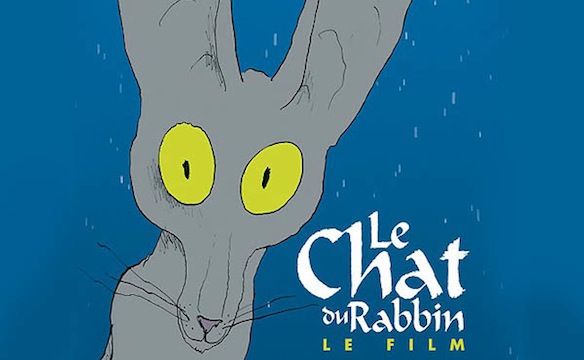
 Seductively stylish and unrelentingly scriptural, The Rabbi’s Cat is the most visually appealing piece of religious propaganda since Davey & Goliath. That said, both would be a helluva lot more re-watchable if they weren’t so goddamn preachy.
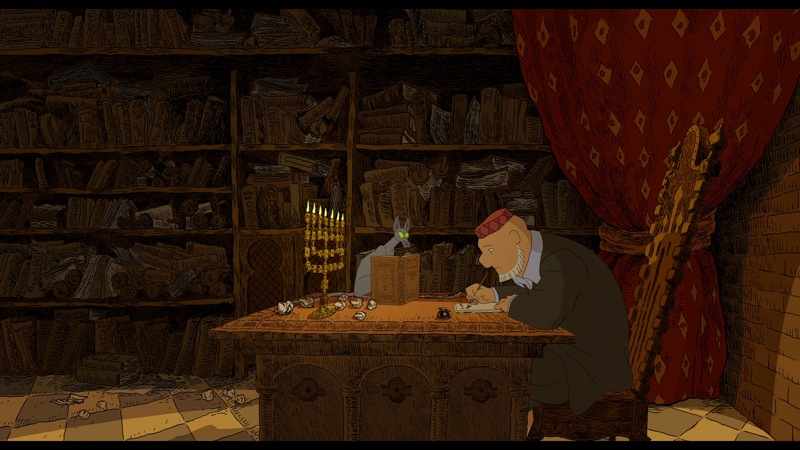
Based on the comic books by Joann Sfar, The Rabbi’s Cat is the tale of a wise and witty religious philosopher…and his Rabbinical owner. The story begins when the titular cat eats a trained parrot, thereby miraculously gaining the ability to speak. From there, it’s a road trip of sorts, as we follow the cat and the Rabbi as they travel around, having impromptu theological discussions with everyone they encounter.

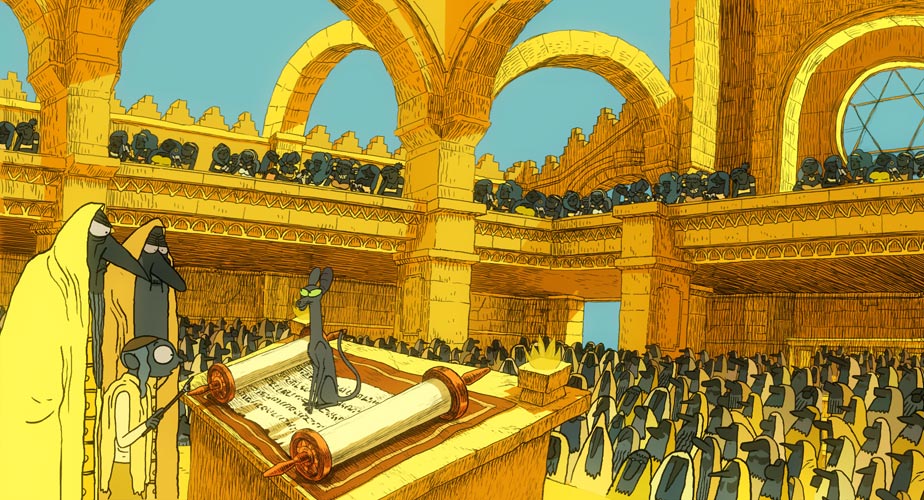
The film is set in 1920s (30s?) Algeria. This provides directors Joann Sfar and Antoine Delesvaux with the perfect opportunity to fill the screen with detailed shots of the country’s crowded cities, aging architecture and idiosyncratic inhabitants. As the accompanying screen-caps attest, the results are SUMPTUOUS.
If only The Rabbi’s Cat was ALL beautiful backgrounds and quirky characters, I might have been able to recommend it more. Unfortunately, there’s far too much preaching and pontificating in this film for folks who aren’t searching for faith through cartoons.

Quick show of hands:
Are you a religious person? A dabbler in deities? The self-professed ‘spiritual’ sort who buys Tarot cards and scented candles in an effort to align yourself with something larger? Stick around. You may like what you see.
On the other hand…
Are you an affirmed atheist? An unapologetic agnostic? The type of person who flinches at the sight of religious paraphernalia the way a vampire does? Then this may not be the flick for you.
Me, personally? I’m not religious at all. My parents were vehemently religious, so much so that my brother is now a minister and my sister and I are damned. Even so, I find some theological debates fascinating. After all, who doesn’t like to hear smart people argue incredible ideas? Now swap out one of those smart people for a talking cat. The results should be cartoon crack, right?
Nope.
Maybe if The Rabbi’s Cat took a less-is-more approach, sprinkling in the tenets of Judaism here and there, I might’ve enjoyed it more. But it doesn’t. With the exception of a few brief, blessed interruptions, it’s pretty much one long sermon from beginning to end.
Or, as my sister and I used to refer to our childhood church: Nap-time.
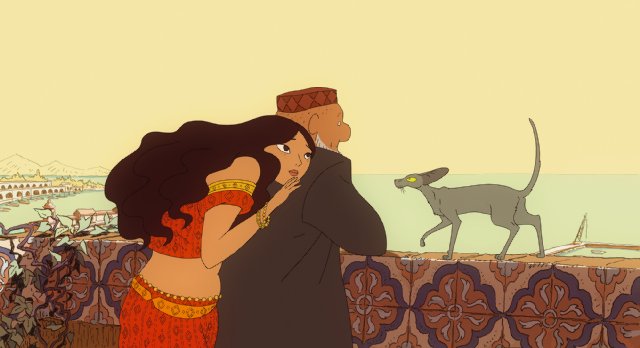
As for the NON-scriptural bits scattered throughout? I LOVED THEM. My favorites were those that focused on the Rabbi’s daughter, Zlabya, and the cat. Their playful interactions and flirty conversations are so much fun to watch. These scenes sparkle, bringing to mind everything from Jane Austen novels to Howard Hawks’ romantic comedies.
If only there were more.
(Not to sound cartoon-creepy, but the small pot-belly given to Zlabya is probably the single cutest cartoon touch I saw this year. Anyone remember Fabienne’s pot-belly speech from Pulp Fiction? The character designs in The Rabbi’s Cat prove her point perfectly.)
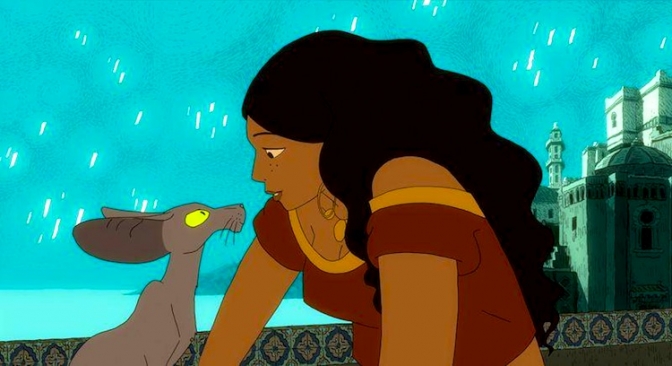
The animation in The Rabbi’s Cat is pretty much as it appears in the screen-caps. Classic, clean-lined, French cartooning. This varies a li’l in a couple of places, though. The cat’s dreams, as well as a story told by a Russian exile, are animated in hyper-colorful, super surreal styles. Think: Pink Elephants as directed by Bill Plympton, or an Art Spiegelman adaptation of Fiddler on the Roof.
This is one of those rare films that you can pause on any frame and the outcome is always the same — GORGEOUSNESS. Honestly, I can’t praise the look of this film enough. I found it flawless.
Olivier Daviaud’s score is also a delight, a Middle Eastern mélange of Arabic and Jewish music, with just a touch of 1960s Henry Mancini.
In the end, I’d put The Rabbi’s Cat in the same league as that other bit of un/orthodox animation, Art Clokey’s Davey & Goliath. Both feature semi-serious, semi-comic relationships between pets and their owners. Both boast beautiful, handmade visuals that I find incredibly, irresistibly charming. And — as sacrilegious as it sounds — both would be a helluva lot more re-watchable if they concentrated less on God and faith and more on the kids and their talking pets.
The Rabbi’s Cat is currently available on Netflix Streaming, or can be viewed for $4 on Amazon.